FAIR enabled
The OpenAIRE and DRIVER guidelines, at the beginning of their time in 2006, had already put the focus on elements that can be found today in the FAIR principles. Community-based refinement and enhancement of the guidelines over time to include elements with their descriptions that are consistent with motivation of FAIR. The following section describe the FAIRification process of the OpenAIRE Guidelines for institutional & thematic Repository Manager.
Overview
The FAIR maturity model: specification and guidelines of the Research Data Alliance (RDA) (DOI: 10.15497/rda00050) has the aim to specify the objective indicators for the FAIR assessment. The guidelines are intended to assist evaluators to implement the indicators in the evaluation approach or tool they manage.
The evaluation level analyse is done thru the RDA FAIR Data Maturity specification sheet provided at https://www.rd-alliance.org/system/files/FAIR_evaluation_levels_v0.01.xlsx. The result of this evaluation shows the figure below.
In the case of Findability indicators
RDA-F2-01M: Rich metadata is provided to allow discovery
RDA-F4-01M: Metadata is offered in such a way that it can be harvested and indexed
are implicit covered.
In such a case for Accessibility indicators
RDA-A1-02M: Metadata can be accessed manually (i.e. with human intervention)
RDA-A1-04M: Metadata is accessed through standardised protocol
are implemented via the standardized OAI-PMH interface.
And for Reusability indicator
RDA-R1.3-02M: Metadata is expressed in compliance with a machine-understandable community standard
is implicit covered by the guidelines.
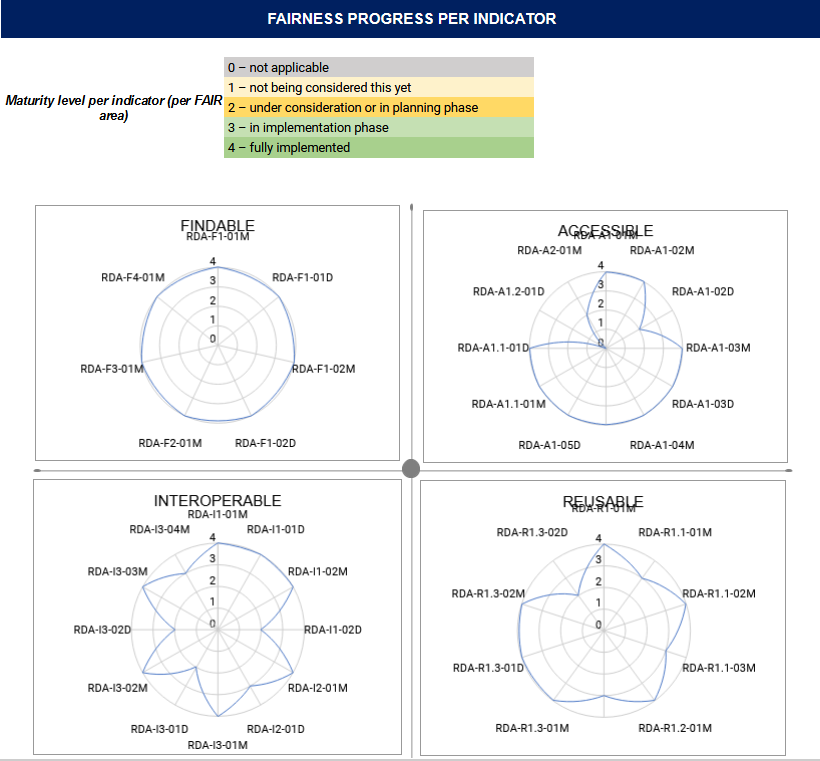
Out of the scope of these guidelines are the indicators:
RDA-A1-02D: Data can be accessed manually (i.e. with human intervention)
RDA-A2-01M: Metadata is guaranteed to remain available after data is no longer available
RDA-I2-01D: Data uses FAIR-compliant vocabularies
RDA-I3-01D: Data includes references to other data
RDA-I3-02D: Data includes qualified references to other data
Not directly supported or crosswalks exists are:
RDA-A1.2-01D: Data is accessible through an access protocol that supports authentication and authorisation
RDA-I1-02D: Data uses machine-understandable knowledge representation
RDA-R1.2-01M: Metadata includes provenance information according to community-specific standards
RDA-R1.2-02M: Metadata includes provenance information according to a cross-community language
RDA-R1.3-01D: Data complies with a community standard
RDA-R1.3-02D: Data is expressed in compliance with a machine-understandable community standard